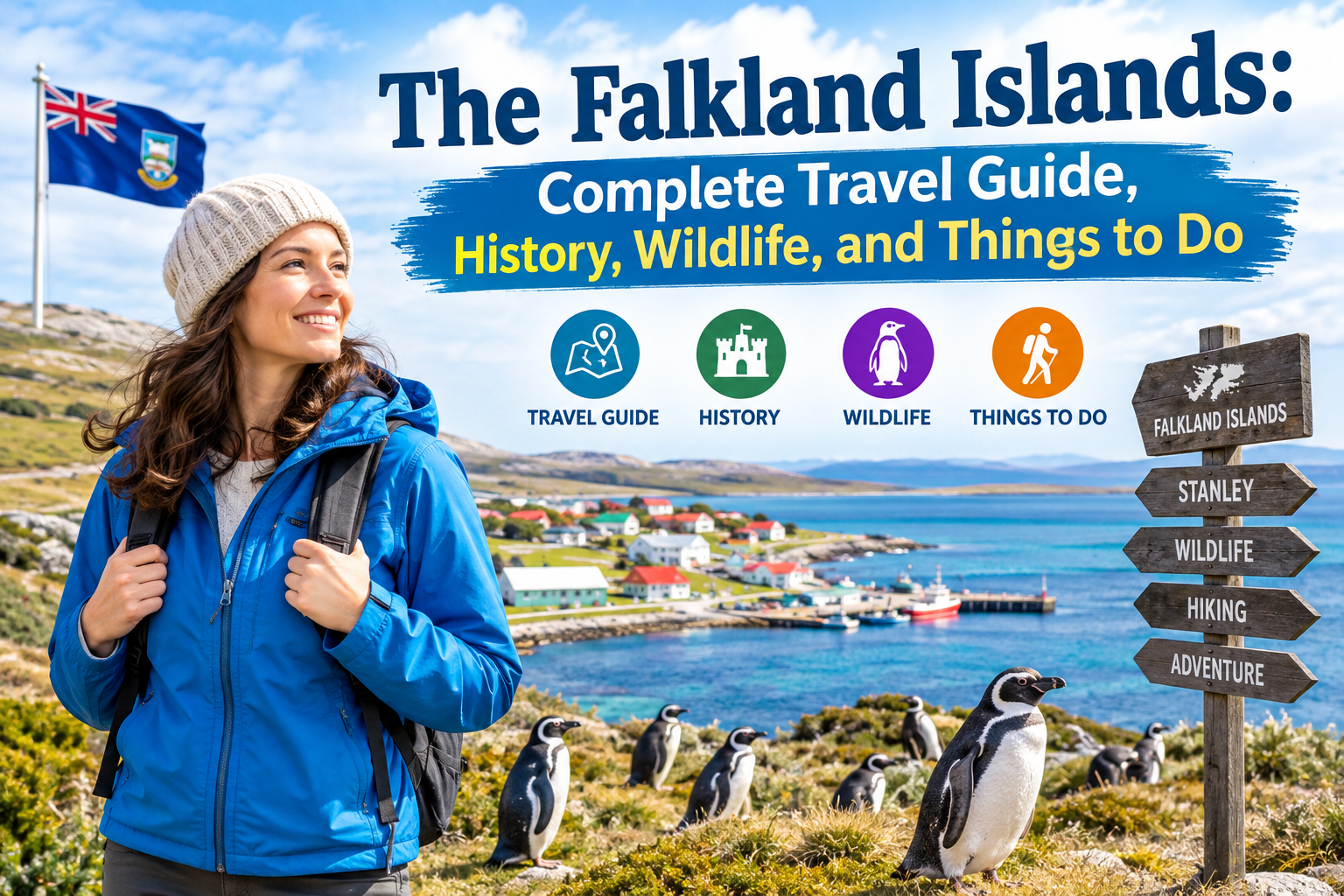
The Falkland Islands are one of the world’s most distinctive remote travel destinations. Located in the South Atlantic Ocean, this windswept archipelago combines dramatic coastlines, wide-open landscapes, colorful settlements, historic battlefields, traditional island hospitality, and remarkable wildlife.
For many travelers, the biggest attraction is the wildlife. The islands are home to several penguin species, seals, sea lions, albatrosses, petrels, dolphins, and other marine and birdlife. Five species of penguin breed in the Falklands, while destinations such as Volunteer Point offer opportunities to see large king penguin colonies. (Falkland Islands)
But the Falklands are about much more than penguins. A visit can include walking across remote hills, exploring Stanley, learning about island life at the Historic Dockyard Museum, visiting 1982 battlefield sites, photographing shipwrecks and beaches, and traveling between remote settlements by small aircraft.
Because the islands are remote and travel infrastructure is limited compared with mainstream tourist destinations, planning is particularly important. Accommodation, inter-island flights, transfers, and tours should generally be organized before arrival, especially during the December-to-February high season. (Falkland Islands)
This complete Falkland Islands travel guide covers what to see and do, when to visit, wildlife, history, hiking, food, packing, transportation, and photography.
1. Falklands Travel Guide
The Falkland Islands are an archipelago of more than 700 islands and islets, although only some are inhabited or regularly visited by tourists. The two principal islands are East Falkland and West Falkland, with numerous smaller islands scattered around them. The landscape ranges from rocky hills and stone runs to beaches, cliffs, grasslands, wetlands, and exposed coastal environments. (Falkland Islands)
The capital, Stanley, is located on East Falkland and is the main starting point for many visitors. It is also the administrative and commercial center of the territory.
How to get to the Falkland Islands
Traveling to the Falklands requires more planning than a typical international holiday.
International visitors can currently arrive by air through South America or on flights operated from the United Kingdom. The Falkland Islands tourism authority lists a regular LATAM service connecting Santiago, Chile, with Mount Pleasant Airport, with a stop at Punta Arenas. There are also UK-operated flights from RAF Brize Norton, with limited civilian seats available. (Falkland Islands)
Mount Pleasant Airport is the main international airport. It is on East Falkland, and onward transportation to Stanley or other destinations needs to be organized.
Cruise travel is another option. Numerous cruise and expedition ships include the Falklands in South Atlantic and Antarctic itineraries. A cruise can provide an introduction to Stanley and, depending on the itinerary, other locations, although a land-based trip generally gives you considerably more time to explore. (Falkland Islands)
How to travel around the islands
One of the most memorable parts of visiting the Falklands is simply getting around.
The Falkland Islands Government Air Service (FIGAS) operates small aircraft connecting Stanley with settlements, farms, and outer islands. Rather than operating like a conventional airline with a fixed timetable, FIGAS works more like an air-taxi service. Flight schedules are determined according to passenger requirements and operational considerations. (Falkland Islands)
For visitors, this means an inter-island flight can itself become part of the adventure.
You may fly over:
- Open grasslands
- Beaches and bays
- Rocky hills
- Sheep farms
- Remote settlements
- Penguin colonies
- Coastal cliffs
- Vast stretches of seemingly untouched landscape
The aircraft are small, and landing strips on many islands are grass or other non-standard surfaces. (Falkland Islands)
Road travel is another option, particularly on East and West Falkland. Four-wheel-drive vehicles are commonly used because some roads and tracks can be rough and conditions can change rapidly. Local guides can be especially valuable when visiting wildlife sites or remote areas. (Falkland Islands)
Independent travel or organized tour?
Both are possible.
Independent travel gives you greater control over your itinerary, while an organized trip can simplify transportation, accommodation, wildlife excursions, and inter-island flights.
The remote nature of the destination makes advance planning particularly important. The official tourism authority recommends booking accommodation ahead of time because many locations have limited rooms, particularly during the December-to-February high season. (Falkland Islands)
A good itinerary might combine:
Stanley → East Falkland wildlife → remote island → West Falkland → Stanley
Alternatively, travelers with limited time can base themselves in Stanley and take day trips.
How long should you stay?
There is no single ideal length of trip.
A short visit can provide time for Stanley, a wildlife excursion, and perhaps a battlefield tour. A longer trip allows you to explore the outer islands and experience the remote character of the Falklands more fully.
The official tourism material notes that trips can range from only a few days to several weeks, with around 10 days cited as an average stay in one general visitor publication. (Falkland Islands)
If wildlife photography is your main goal, allowing additional days provides more flexibility for weather and transportation changes.
2. Stanley Travel & Attractions
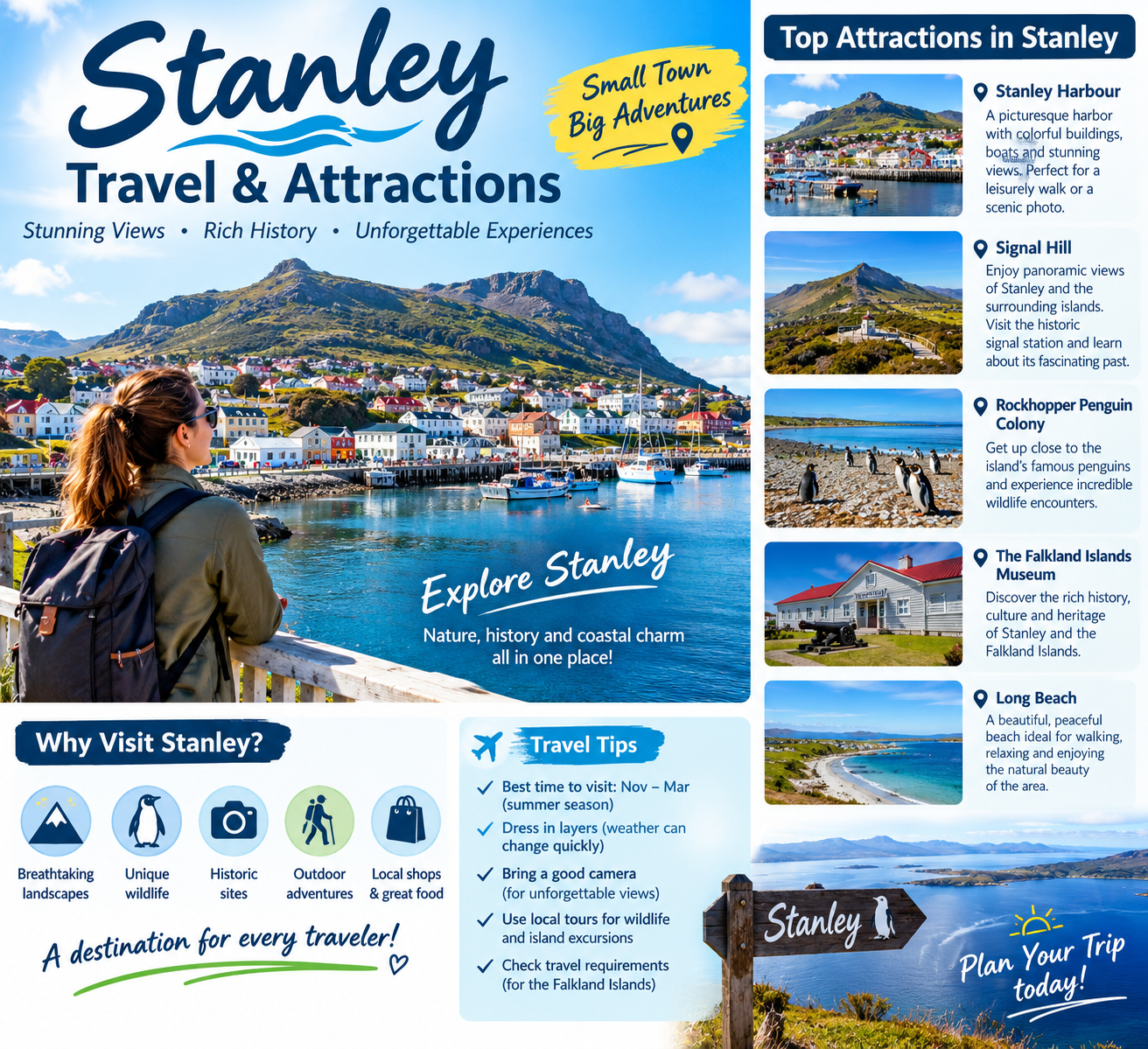
Stanley is the natural introduction to the Falkland Islands.
Stretching around a sheltered harbor, the capital has a distinctive appearance influenced by British maritime heritage and the island’s own history. Although it is officially a city, Stanley remains small enough to explore comfortably on foot. (Falkland Islands)
Christ Church Cathedral
One of Stanley’s most recognizable landmarks is Christ Church Cathedral, described by the Falkland Islands tourism authority as the world’s most southerly Anglican cathedral.
The cathedral contains stained glass, flags, banners, memorials, and other objects connected with island life. Outside, the famous whalebone arch is an especially recognizable photographic feature.
The cathedral is not simply a religious building; it is part of the visual and historical identity of Stanley.
Historic Dockyard Museum
The Historic Dockyard Museum is one of the most important stops for first-time visitors.
The museum explores the social, maritime, agricultural, and military history of the islands. Exhibits include models, maritime artifacts, farming-related displays, recreated historical environments, and natural-history material. It also covers the 1982 conflict and earlier periods of settlement. (Falkland Islands)
Allow plenty of time here rather than treating it as a quick stop. The museum helps provide context for many of the landscapes and historical locations you will encounter elsewhere.
Waterfront and Ross Road
Take time to walk along Stanley’s waterfront.
Ross Road provides views across the harbor and contains several recognizable features, including British-style post boxes and telephone boxes.
The harbor is also a good place for photography, particularly when colorful buildings, boats, clouds, and changing South Atlantic light come together.
Lady Elizabeth shipwreck
The Lady Elizabeth, often called “Lady Liz,” is one of Stanley’s most recognizable landmarks.
The steel sailing ship was launched in Sunderland in 1879 and was damaged while rounding Cape Horn in 1913. After arriving in Stanley and remaining there for years, she eventually came to rest at her present location following a gale in 1936. (Falkland Islands)
Today, the rusting wreck provides an atmospheric contrast with Stanley’s colorful buildings and harbor.
Gypsy Cove
Gypsy Cove is one of the easiest wildlife excursions from Stanley.
It is approximately 8.5 kilometers from central Stanley and provides an opportunity to see Magellanic penguins. (Falkland Islands)
Because of its accessibility, Gypsy Cove can be particularly useful for travelers on a short itinerary or cruise passengers with limited time.
Walking around Stanley
Do not spend your entire Stanley visit inside museums.
Walking is one of the best ways to appreciate the town. Look for:
- Historic houses
- Harbor views
- Memorials
- Colorful buildings
- Local shops
- Churches
- Small gardens
- Maritime features
- Shipwreck views
The hills surrounding Stanley also provide wider views over the town and coastline.
3. Penguins & Wildlife
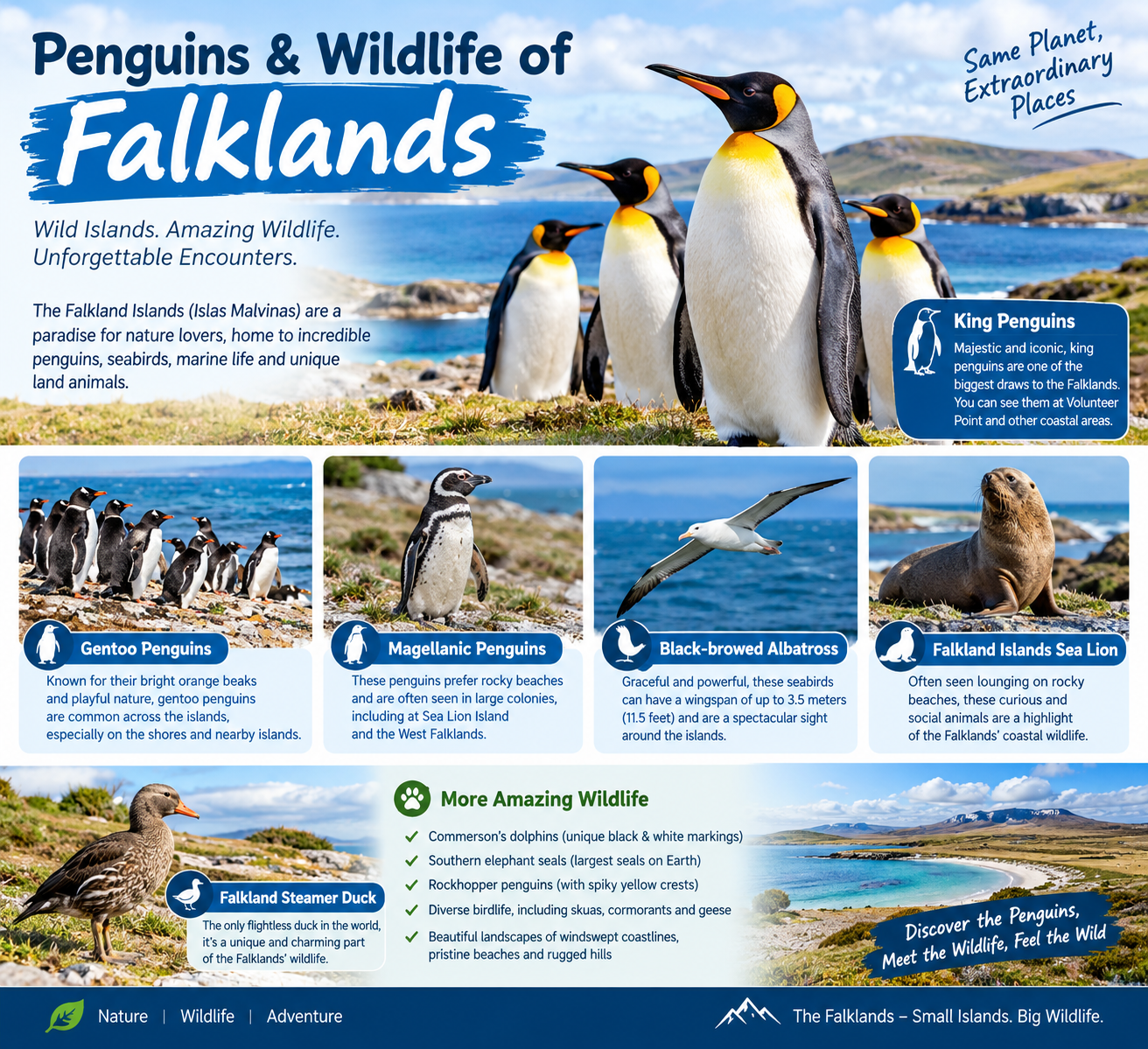
Wildlife is arguably the defining reason many people travel to the Falkland Islands.
The islands support enormous concentrations of seabirds and marine animals, and the absence of large-scale tourism infrastructure in many locations can make wildlife encounters feel remarkably intimate.
The key is to remember that these are wild animals, not performers in a wildlife park.
Penguins:
The Falklands have five breeding penguin species:
- King penguins
- Gentoo penguins
- Magellanic penguins
- Rockhopper penguins
- Macaroni penguins
The first four are generally easier to find, while macaroni penguins can occur among rockhopper colonies. (Falkland Islands)
King penguins
King penguins are among the most spectacular animals in the Falklands.
Volunteer Point is one of the best-known destinations for seeing them. The tourism authority describes the colony as numbering more than 1,000 birds, while more recent tourism material describes around 1,500 breeding pairs. (Falkland Islands)
The journey from Stanley is substantial, involving a roughly two-and-a-half-hour drive, and visitors need a local guide. (Falkland Islands)
The reward is an extraordinary scene of penguins against beaches and open landscapes.
Gentoo penguins
Gentoo penguins are energetic, noisy, and highly entertaining to watch.
They can be found at several locations throughout the islands. Watching them move between nesting areas and the sea can provide excellent photography opportunities.
Rockhopper penguins
Rockhopper penguins are particularly memorable because of their distinctive yellow-and-black head markings and energetic behavior.
They inhabit rocky coastal areas and can be seen on some day trips from Stanley, including trips to areas around Murrell Farm. (Falkland Islands)
Magellanic penguins
Magellanic penguins are another important species and are accessible at places such as Gypsy Cove.
They may nest in burrows, so visitors should be particularly careful about where they step.
Seals and sea lions
Penguins are only part of the wildlife story.
The islands are home to:
- Southern elephant seals
- South American fur seals
- Southern sea lions
Elephant seals are particularly impressive because they are the world’s largest pinnipeds. Adult males can be enormous and may engage in dramatic territorial contests. (Falkland Islands)
Always give seals and sea lions plenty of space. Their apparent inactivity can be misleading, and large animals can move surprisingly quickly.
Birds
Birdwatchers can find an impressive variety of species.
Among the highlights are:
- Black-browed albatross
- Southern giant petrel
- Striated caracara
- Cobb’s wren
- Falkland flightless steamer duck
- Tussac bird
The Falklands are particularly interesting for photographers because many seabirds can be observed in coastal environments without the dense crowds found at some famous wildlife destinations. (Falkland Islands)
Whales and dolphins
More than 20 cetacean species have been recorded around the Falklands, including whales and dolphins. Orcas are also regular visitors, while increasing sightings of sei whales have been reported. (Falkland Islands)
Seeing a whale blow or dolphins from a boat or aircraft is never guaranteed, but the possibility adds another dimension to island travel.
Wildlife etiquette
Wildlife photography should never come at the expense of animal welfare.
The Falklands’ visitor guidance recommends keeping approximately 6 meters away from wildlife, while also emphasizing that some animals may approach visitors themselves. Never block an animal’s route to the sea or interfere with natural behavior. (Falkland Islands)
A good rule is:
Let the animal decide the distance.
Do not chase, surround, feed, touch, or attempt to attract wildlife for a photograph.
4. Hiking & Outdoor Activities
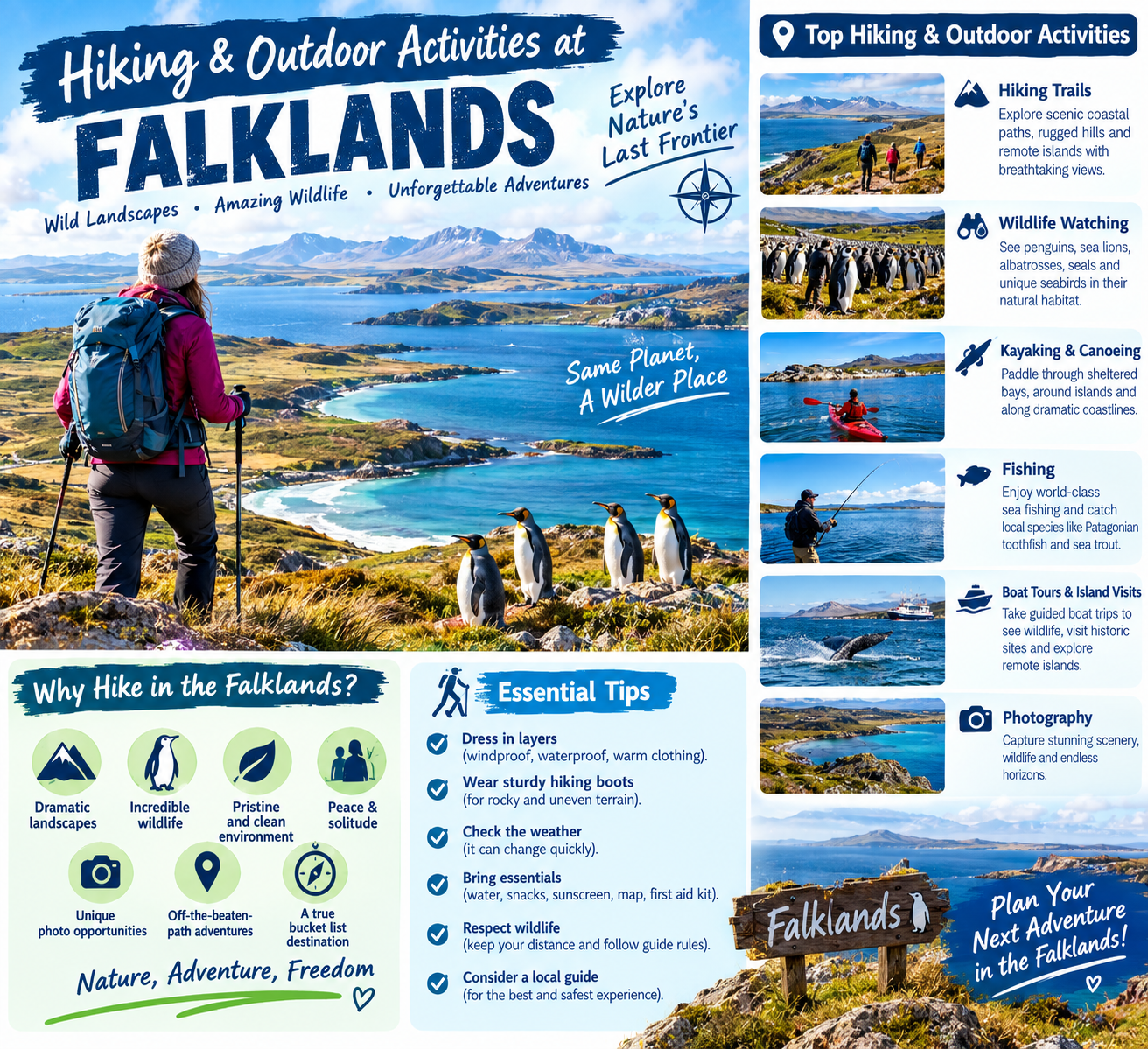
The Falkland Islands are exceptionally appealing to travelers who enjoy outdoor experiences.
There are no need for amusement parks or artificial attractions when the landscape itself is the experience.
Hiking
Walking routes range from relatively easy coastal walks to demanding excursions over hills and remote terrain.
Popular walking experiences include:
- Coastal hikes
- Beach walks
- Hill walks
- Battlefield walks
- Wildlife walks
- Settlement walks
- Remote island treks
The scenery changes constantly.
You might walk through tussac grassland, cross rocky terrain, pass sheep farms, climb a hill overlooking the ocean, or arrive at a remote beach filled with seabirds.
Mount Tumbledown
The hills around Stanley include locations associated with the 1982 conflict.
Mount Tumbledown is both a hiking destination and a historically significant landscape. Walking here can provide a physical understanding of the terrain that played an important role during the war.
Because battlefield areas can contain unexploded ordnance and other hazards, visitors should use established routes and qualified local guides rather than exploring suspicious objects or leaving safe paths.
Stone runs
One of the most unusual geological features of the Falklands is the stone run.
These are striking rivers or streams of angular rocks flowing down hillsides and valleys. They give some parts of the landscape an almost otherworldly appearance.
The Falklands’ geological history is ancient, and the tourism authority notes that rocks and fossils tell a story stretching back roughly one billion years. Charles Darwin also spent time in the Falklands during his voyages and studied local wildlife and fossils. (Falkland Islands)
Fishing
Fishing is another popular outdoor activity.
The islands offer opportunities for both freshwater and marine fishing, depending on location and season. Local operators can provide advice about permits, equipment, conditions, and appropriate areas.
Kayaking and boating
Kayaking can provide a quiet way to explore sheltered coastal environments.
Boat excursions may also provide opportunities to observe:
- Seabirds
- Penguins
- Seals
- Sea lions
- Dolphins
- Whales
Conditions can change quickly, so guided excursions are preferable for visitors unfamiliar with the South Atlantic environment.
Island hopping
Island hopping is one of the signature Falklands experiences.
FIGAS connects many islands and settlements, making it possible to combine several destinations in one trip. The small aircraft offer views that are difficult to obtain any other way. (Falkland Islands)
For travelers who want the full wilderness experience, staying on an outer island can be dramatically different from spending the entire trip in Stanley.
5. Falklands War & History
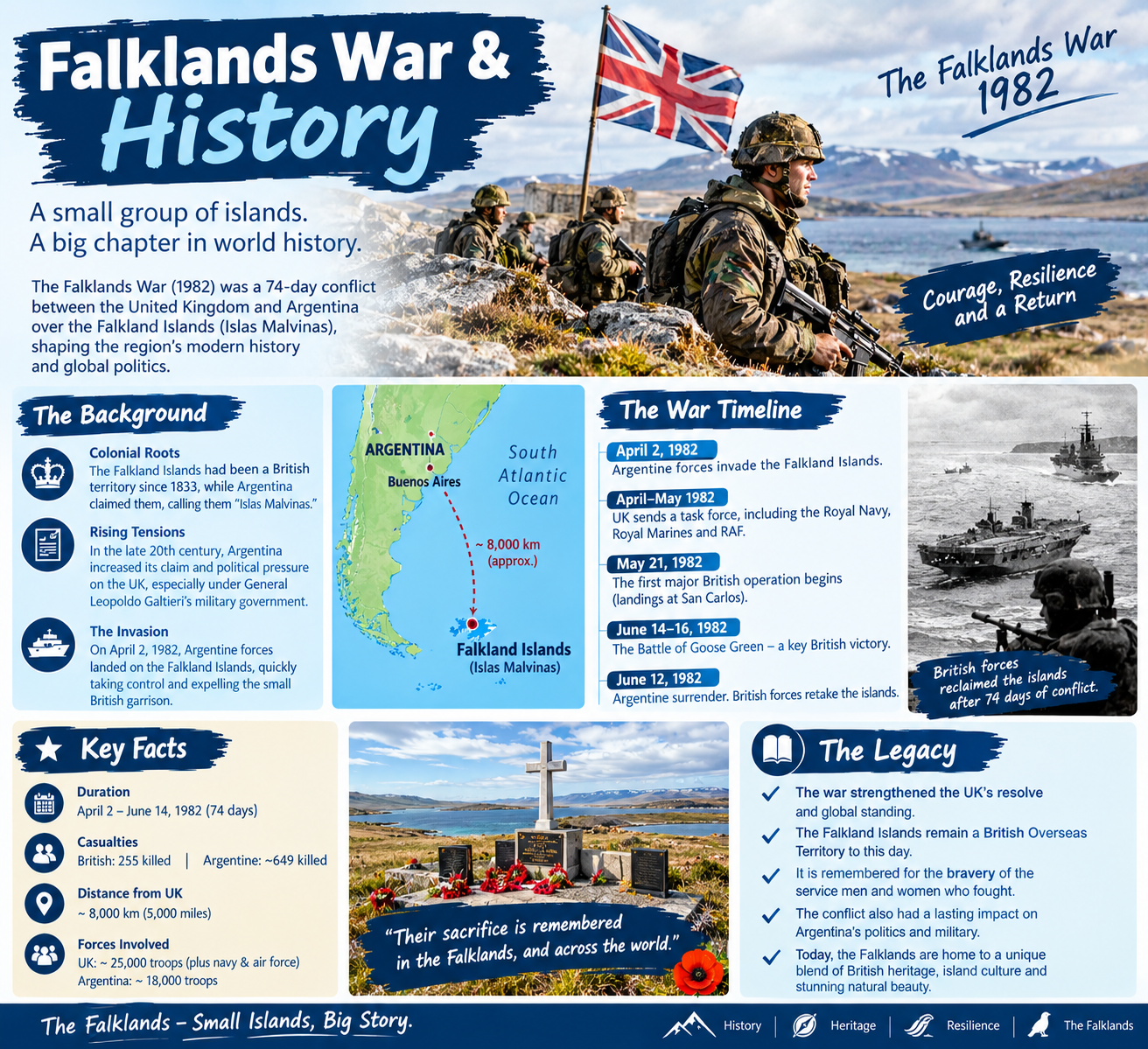
The history of the Falkland Islands is complex and includes European exploration, settlement, maritime activity, farming, changing political control, and the continuing sovereignty dispute between the United Kingdom and Argentina.
The 1982 Falklands War remains the most prominent modern historical event associated with the islands.
The 1982 conflict
On 2 April 1982, Argentine forces invaded the Falkland Islands. Britain responded by sending a naval task force to the South Atlantic. The conflict lasted 74 days. (National Army Museum)
British forces began sailing south in early April, and the campaign eventually involved naval, air, and ground operations.
The conflict included major battles at locations that visitors can now explore as historic landscapes.
Goose Green
The Battle of Goose Green was one of the important land engagements of the campaign.
British forces fought Argentine positions in late May. The battle resulted in a British victory but significant casualties, including the death of Lieutenant Colonel Herbert “H” Jones, who was later awarded the Victoria Cross. (National Army Museum)
Today, the Goose Green area is one of several places where visitors can learn about the campaign and its human cost.
Mount Longdon
Mount Longdon was the scene of one of the fiercest battles of the conflict.
The terrain itself demonstrates why fighting in the Falklands was so difficult. Rocky ridges, exposed slopes, poor weather, and limited cover all affected military operations.
According to the National Army Museum, British forces suffered 23 deaths at Mount Longdon, making it the costliest battle of the war for the British side. (National Army Museum)
Stanley and the end of the war
British forces captured key positions around Stanley during the final phase of the campaign.
The Argentine garrison ultimately surrendered in June 1982.
The National Army Museum records 255 British servicemen and three female civilians killed during the conflict, alongside 649 Argentine military personnel killed. (National Army Museum)
These numbers represent human lives rather than merely historical statistics.
Visitors should approach battlefield tourism respectfully. Memorials, cemeteries, wreckage, abandoned positions, and other sites can be emotionally significant to Islanders, veterans, and families.
Exploring battlefield sites
A battlefield tour can include locations such as:
- Goose Green
- Darwin
- Mount Longdon
- Mount Tumbledown
- Wireless Ridge
- Mount Harriet
- Two Sisters
Local guides can provide geographic and historical context that is difficult to understand from a map alone.
The battlefield landscape is also part of the modern Falklands, where history and everyday island life exist side by side.
6. Weather & Best Time to Visit
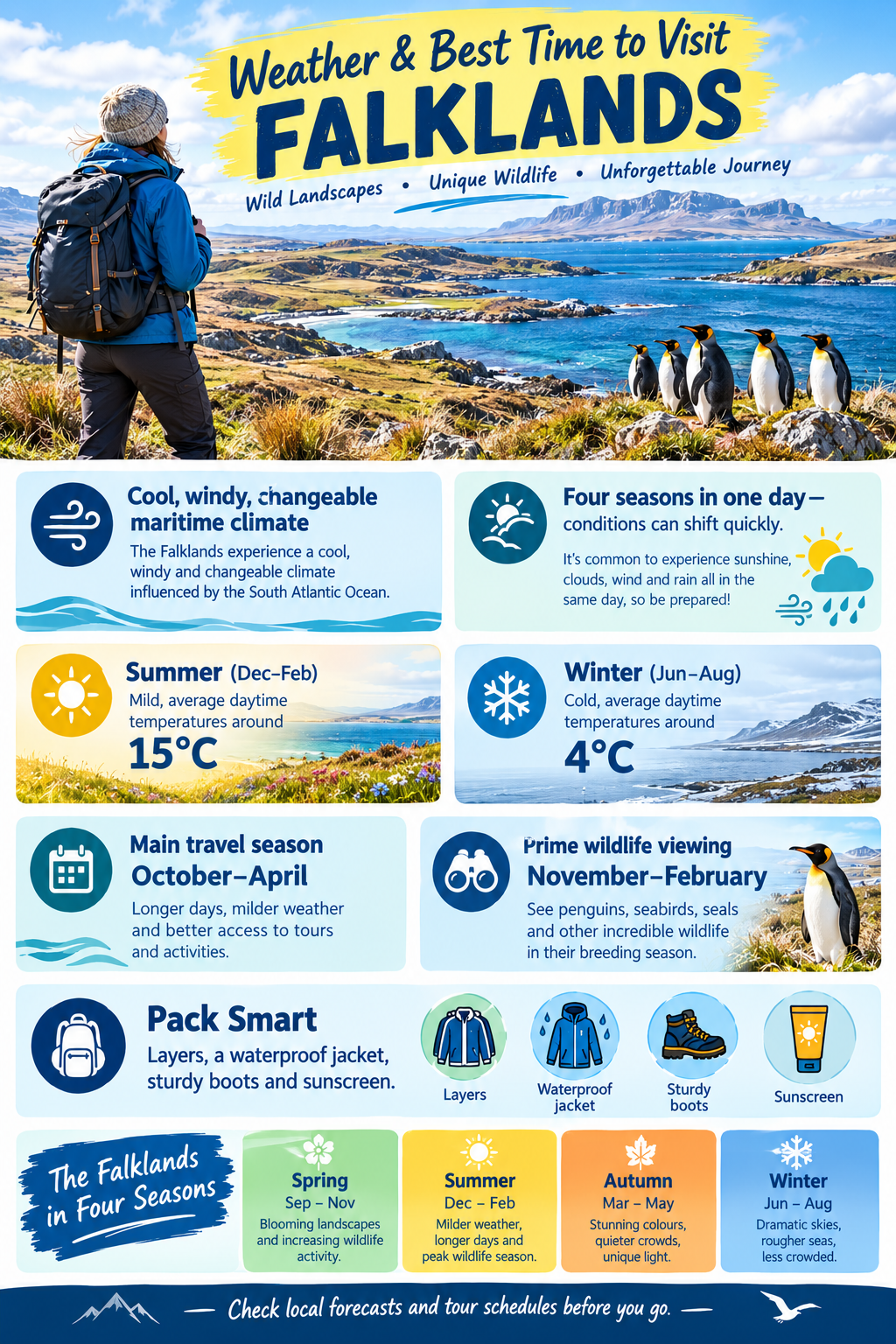
Falklands weather deserves serious attention when planning a trip.
Conditions can change rapidly, and wind is a defining feature of the island climate. The official visitor guidance emphasizes the importance of layers and carrying waterproof clothing because weather conditions can change quickly. (Falkland Islands)
Best time to visit
The Falklands’ summer is generally considered the prime visitor season.
The official tourism authority identifies December, January, and February as the summer months and describes them as the best time to visit, although other seasons offer different wildlife and travel experiences. (Falkland Islands)
December to February
Advantages include:
- Long daylight hours
- Active wildlife colonies
- Warmer conditions
- Excellent opportunities for photography
- Strong penguin activity
- More tourism services operating
This is also the busiest period.
September to November
Spring brings increasing wildlife activity.
Penguins and other birds begin nesting and breeding, making this an exciting time for wildlife enthusiasts. (Falkland Islands)
March and April
Autumn can offer a quieter atmosphere and changing landscapes.
Some wildlife activity remains excellent, while visitor numbers can be lower than during peak summer.
Winter
Winter is considerably quieter.
Not every tourist attraction or accommodation option will operate year-round, and wildlife diversity is lower than during the main season. However, Stanley remains active, and the Historic Dockyard Museum provides a worthwhile cultural and historical experience. (Falkland Islands)
Why weather matters for travel
Weather is not just about comfort.
It can affect:
- FIGAS flights
- Road travel
- Boat excursions
- Hiking
- Wildlife tours
- Photography
- Connecting flights
Build flexibility into your itinerary wherever possible.
If a particular wildlife site is extremely important to you, avoid creating an itinerary where one delayed flight means missing the only opportunity to visit it.
7. Packing, Food & Travel Practicalities
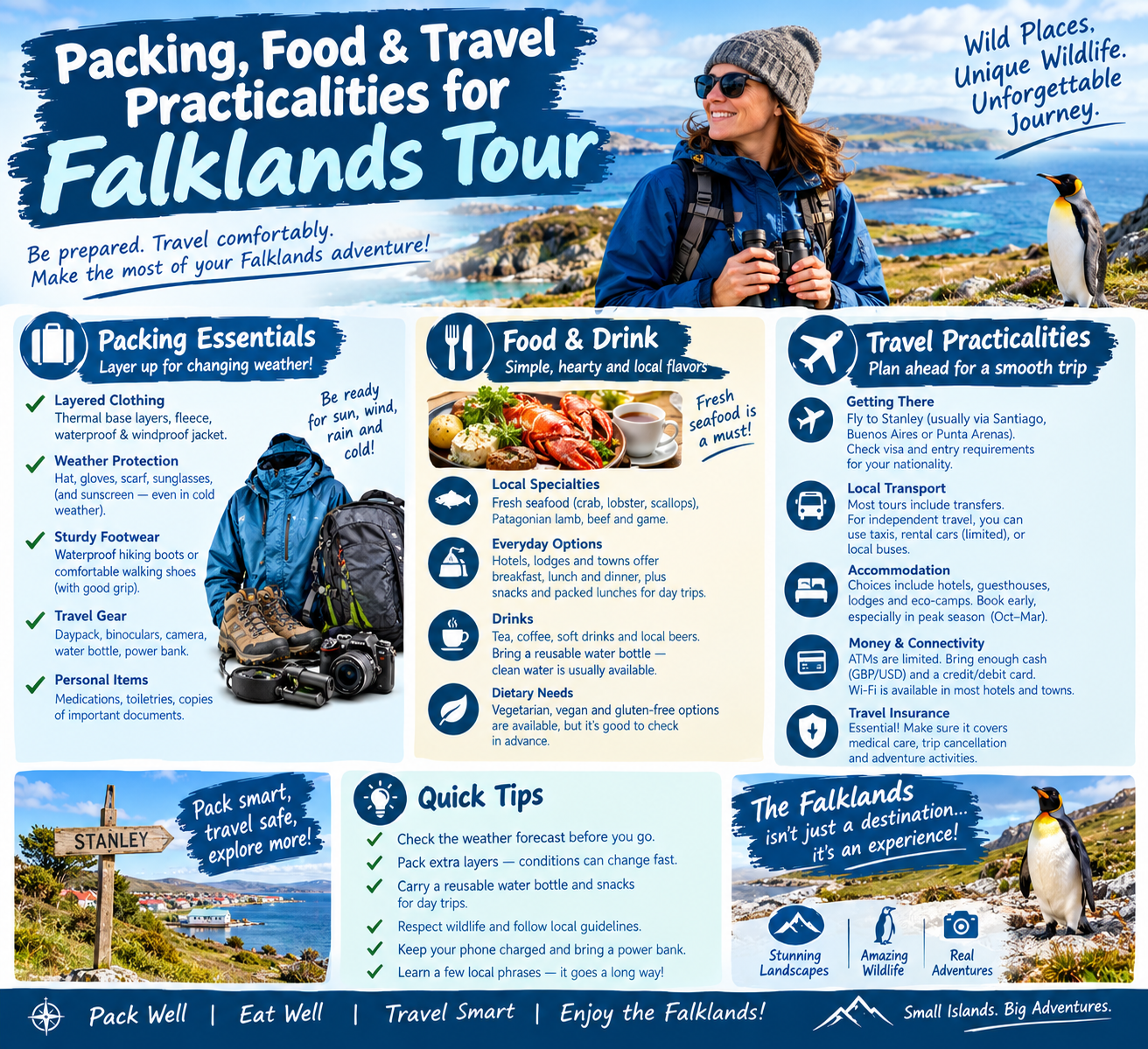
The Falklands reward travelers who pack for practicality rather than fashion.
What to pack
The official visitor guidance recommends layered clothing, waterproof outerwear, strong walking boots for travel outside Stanley, sunscreen, and sufficient prescription medication. (Falkland Islands)
A practical packing list includes:
Clothing
- Waterproof jacket
- Windproof outer layer
- Warm fleece
- Thermal base layers
- Comfortable walking trousers
- Wool or synthetic socks
- Gloves
- Hat
- Comfortable waterproof boots
Photography equipment
- Camera body
- Telephoto lens
- Wide-angle lens
- Spare batteries
- Memory cards
- Lens cloth
- Waterproof camera protection
- Small tripod if appropriate
Personal items
- Sunscreen
- Sunglasses
- Lip balm
- Personal medications
- Reusable water bottle
- Small daypack
- Portable power bank
Do not underestimate the sun.
Even in a cool climate, visitors can burn, and the official safety guidance specifically warns that sunburn can occur easily. (Falkland Islands)
Money and cards
Many businesses accept major currencies and credit cards, but travelers should check before making purchases. The official visitor FAQ notes that US dollars, euros, and cards may be accepted by shops, restaurants, and accommodation providers. (Falkland Islands)
Carry a backup payment method, particularly when traveling away from Stanley.
Food in the Falklands
Falkland Islands cuisine reflects the territory’s isolated geography and farming traditions.
Expect hearty, home-style food rather than a highly specialized restaurant scene.
Local food may include:
- Lamb
- Beef
- Fish
- Seafood
- Potatoes
- Homemade bread
- Cakes
- Biscuits
- Soups
- Traditional desserts
One charming local tradition is “smoko,” a mid-morning or afternoon break involving tea, coffee, cakes, biscuits, and other baked treats. The tourism authority specifically highlights the tradition as part of Falkland hospitality. (Falkland Islands)
Accommodation
Visitors can choose from several accommodation styles:
- Stanley hotels
- Guesthouses
- Bed-and-breakfasts
- Self-catering accommodation
- Farm stays
- Remote island lodges
- Camping options
Accommodation outside Stanley can be limited, so reserve early.
Driving
The Falklands drive on the left.
Outside Stanley, road conditions can be very different from those encountered in major cities. Some routes are rough tracks rather than conventional paved roads.
The official safety guidance states that the maximum speed on regulated roads is 40 mph (64 km/h). (Falkland Islands)
If hiring a vehicle, understand the route and weather conditions before setting out.
Safety
The Falklands are generally considered a very safe destination in terms of ordinary crime. The greater risks come from weather, wildlife, road conditions, and remote terrain. (Falkland Islands)
In remote countryside:
Preparation is more important than speed.
Carry extra clothing, tell someone where you are going, and avoid assuming that mobile coverage or immediate assistance will always be available.
Unexploded ordnance
Because of the 1982 war, certain areas may contain mines or unexploded military material.
Never touch, move, collect, or investigate suspicious objects.
Stay on established routes and follow local guidance.
8. Photography
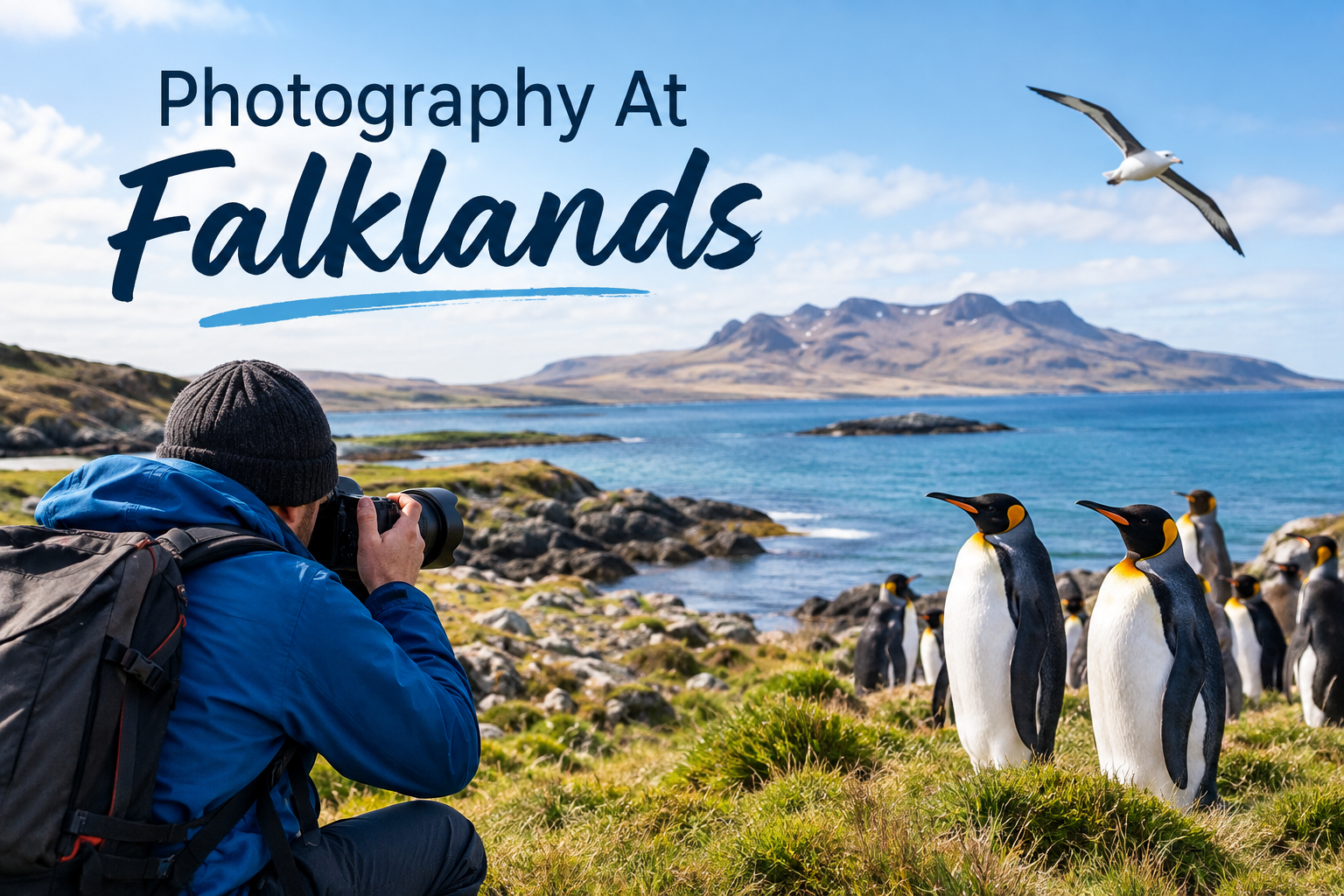
For photographers, the Falkland Islands can be extraordinarily rewarding.
The combination of wildlife, dramatic weather, open landscapes, colorful Stanley buildings, shipwrecks, and historical sites provides enormous variety.
Wildlife photography
A telephoto lens is useful for wildlife.
However, a common mistake is assuming that the longest possible lens is always best.
Because wildlife can sometimes be relatively accessible, a moderate telephoto lens may allow you to capture both the animal and its environment.
Try photographing:
- Penguins walking toward the ocean
- King penguins standing in groups
- Rockhoppers among rocks
- Albatrosses flying above cliffs
- Elephant seals resting on beaches
- Sea lions in the surf
- Seabirds against the sky
- Penguins silhouetted at sunset
Use fast shutter speeds for birds in flight and moving animals.
For static subjects, experiment with slower shutter speeds when conditions allow.
Landscape photography
The Falklands are ideal for wide-angle landscape photography.
Look for:
- Beaches
- Rocky cliffs
- Stone runs
- Tussac grass
- Hills
- Harbors
- Open roads
- Remote settlements
- Dramatic cloud formations
Do not photograph everything from eye level.
Try low perspectives for foreground texture, elevated viewpoints for landscape scale, and long lenses for compressing distant hills and coastlines.
Stanley photography
Stanley offers some of the most recognizable photographic subjects in the Falklands.
Consider photographing:
- Christ Church Cathedral
- Whalebone arch
- Colorful houses
- Ross Road
- The harbor
- Lady Elizabeth
- Red telephone boxes
- Boats
- Memorials
- Sunset over the waterfront
Early morning and late afternoon can provide softer light and fewer people.
Photographing penguins responsibly
Wildlife photography requires patience.
Instead of approaching an animal to fill your frame, find a comfortable observation point and wait.
Avoid:
- Blocking penguin pathways
- Chasing animals
- Using food to attract wildlife
- Touching animals
- Entering restricted nesting areas
- Making loud noises to get attention
The official countryside guidance emphasizes maintaining distance and allowing wildlife to behave naturally. (Falkland Islands)
The best wildlife photograph is not necessarily the closest photograph.
Sometimes a wider image showing thousands of penguins against a huge landscape tells a much stronger story.
Final Thoughts: Why Visit the Falkland Islands?
The Falkland Islands offer a style of travel that is increasingly difficult to find.
This is not primarily a destination for shopping malls, nightlife, luxury resorts, or crowded attractions. It is a place for wildlife, landscapes, history, walking, photography, and genuine encounters with island life.
A trip can begin in Stanley, where colorful buildings, museums, memorials, churches, and the harbor introduce you to Falklands culture. From there, you can travel into the countryside, visit penguin colonies, walk across historic battlefields, fly in a small FIGAS aircraft to an outer island, photograph seabirds, or simply stand on an empty beach listening to the South Atlantic.
The wildlife is a major attraction. Five penguin species breed in the islands, while seals, sea lions, albatrosses, petrels, dolphins, and whales add to the extraordinary natural environment. (Falkland Islands)
The history is equally important. The 1982 war left a permanent mark on the islands, and battlefield sites and memorials provide an opportunity to understand an event that shaped the modern Falklands. (National Army Museum)
And then there is the landscape itself.
The wide skies, rocky hills, windswept beaches, stone runs, isolated farms, and remote islands create a feeling of space that is difficult to reproduce anywhere else.
For travelers planning a visit, the most important advice is simple: plan ahead, allow flexibility, respect wildlife, prepare for rapidly changing weather, and give yourself enough time to experience more than Stanley.
Whether your primary interest is Falklands travel, Stanley attractions, penguins and wildlife, hiking, military history, photography, or remote island adventures, the Falkland Islands offer an unusually rich travel experience in one of the world’s most isolated corners.
Quick Falkland Islands Travel Checklist
- Main gateway: Mount Pleasant Airport
- Capital: Stanley
- Main islands: East Falkland and West Falkland
- Best-known wildlife: King, gentoo, Magellanic and rockhopper penguins, plus macaroni penguins
- Major wildlife destination: Volunteer Point
- Easy penguin excursion: Gypsy Cove
- Key museum: Historic Dockyard Museum
- Historic attractions: 1982 battlefield sites and memorials
- Main inter-island transport: FIGAS
- Popular activities: Wildlife watching, hiking, photography, fishing, kayaking, boating and island hopping
- Peak travel season: December to February
- Essential clothing: Layers, waterproof jacket and strong walking boots
- Wildlife rule: Keep your distance and never interfere with natural behavior
- Planning tip: Reserve accommodation and transportation in advance
The Falkland Islands are best approached not as a conventional holiday destination, but as an adventure into a remote South Atlantic wilderness where history, wildlife and everyday island life exist side by side.