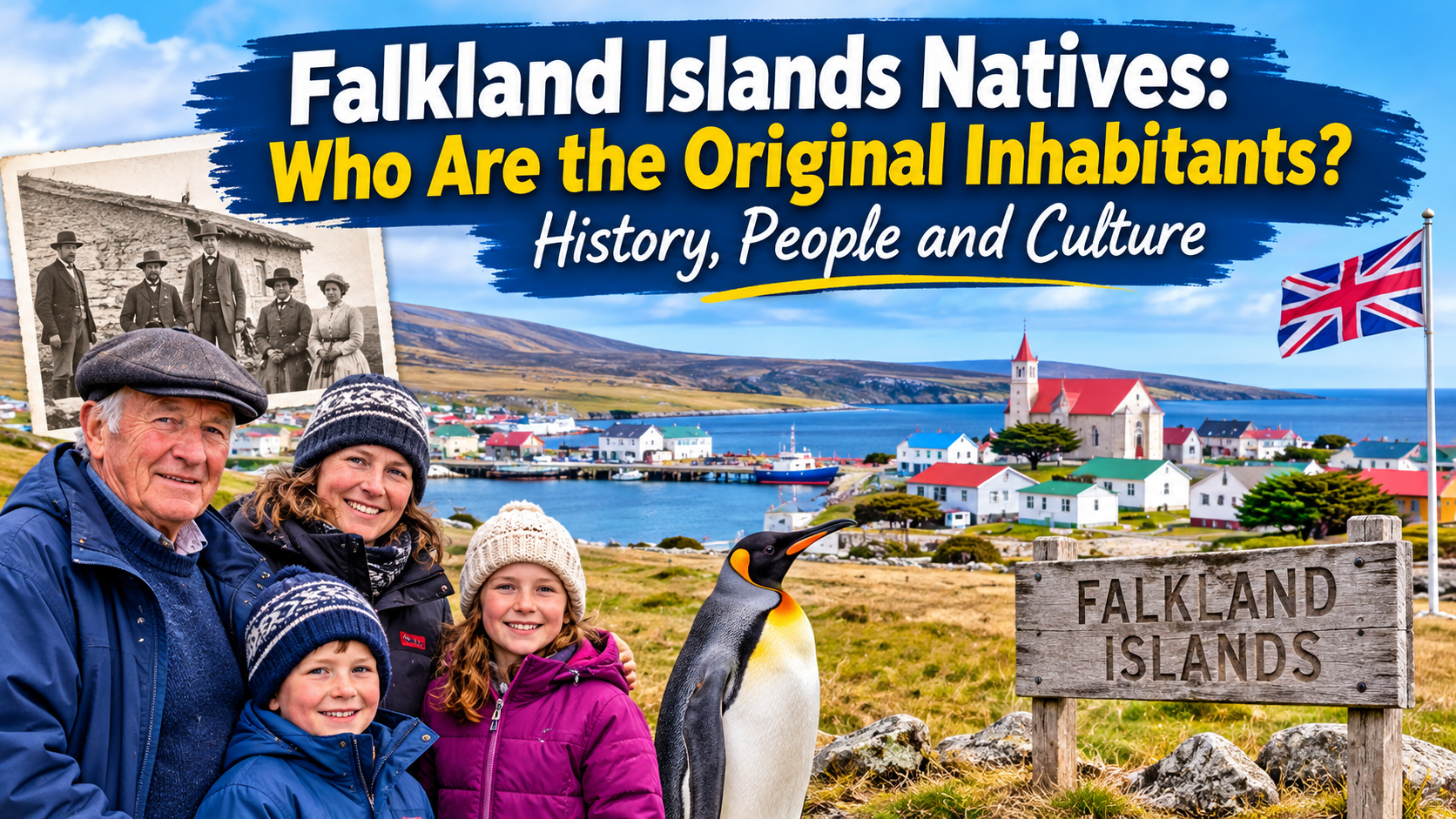
The Falkland Islands are a remote group of islands in the South Atlantic Ocean, known for their dramatic landscapes, penguin colonies, sheep farms, and distinctive local culture. Although thousands of travelers visit to experience the wildlife and scenery, many people have another question: Who are the Falkland Islands natives, and who were the original inhabitants of these islands?
The answer involves a fascinating combination of history, migration, European settlement, and archaeological research. Unlike many destinations around the world, the Falkland Islands have a history of human settlement that remains the subject of scientific discussion.
Today, the local population is commonly known as Falkland Islanders. Their culture has developed through generations of settlement, particularly from Britain and other parts of Europe. However, questions about whether Indigenous South American peoples visited the islands before European arrival have attracted growing attention from researchers.
In this guide, we explore the origins of the Falkland Islands population, the history of settlement, the evidence surrounding possible pre-European visitors, and the culture of the people who call the islands home today.
1. Who Are the Falkland Islands Natives?
The term “Falkland Islands natives” is often used online to describe the people who originally lived on the islands or the people born and raised there.
However, these meanings are not identical.
In everyday conversation, a native Falkland Islander may mean someone who was born in the islands and belongs to the local community. In historical and anthropological discussions, the term usually refers to Indigenous peoples who inhabited a territory before colonial settlement.
The modern Falkland Islands population developed primarily through European settlement, with strong British cultural, linguistic, and institutional influences. Over generations, local families established communities, farms, businesses, and traditions that became distinctively Falkland Islander.
The question of whether Indigenous people lived in the islands before European settlement is more complicated. The traditional historical account holds that there was no established Indigenous population when Europeans began arriving. Nevertheless, archaeological research has raised the possibility that people from southern South America visited the islands much earlier.
It is therefore important not to assume that the modern population and any possible prehistoric visitors represent the same historical group.
2. Did Indigenous People Live in the Falkland Islands Before Europeans?
One of the most interesting questions about the Falkland Islands is whether Indigenous South Americans reached the islands before European explorers.
The islands lie east of southern South America, relatively close to the region of Tierra del Fuego. Indigenous peoples in this southern region developed remarkable maritime skills and relied heavily on marine resources.
Some researchers have suggested that people associated with the Yaghan, also known as the Yámana, or related maritime communities might have reached the Falkland Islands before European exploration.
These peoples traditionally used canoes to travel through the waters around Tierra del Fuego and the Beagle Channel. Their knowledge of coastal environments enabled them to hunt marine mammals, gather shellfish, and move between locations.
However, the fact that Indigenous communities possessed advanced seafaring skills does not, by itself, prove that they settled in the Falkland Islands.
A 2021 scientific study published in Science Advances presented several lines of evidence consistent with prehistoric human activity in the islands. These included changes in charcoal records, deposits of marine animal bones, and a stone projectile point discovered on New Island.
The researchers suggested that these findings could indicate visits by people centuries before Europeans arrived. However, a separate scholarly review published in 2024 concluded that the available evidence for pre-European human presence remained uncertain.
Consequently, it is more accurate to describe prehistoric Indigenous visits as a scientific possibility rather than an established historical fact.
3. The Mystery of the Falkland Islands’ First Inhabitants
The origins of the islands’ earliest human visitors, if any existed, remain an intriguing historical question.
The Falkland Islands are separated from mainland South America by open ocean. Reaching them would have required a sea journey, whether intentional or accidental.
For researchers, the central challenge is finding reliable evidence that distinguishes human activity from natural processes.
Archaeologists and environmental scientists examine several types of evidence when investigating possible early settlement.
Archaeological artifacts
Stone tools, projectile points, and other objects can help researchers understand whether people visited a particular location.
A stone projectile point found on New Island was examined as part of the 2021 study. Its material and characteristics were considered consistent with technologies used by Indigenous peoples in southern South America.
However, an isolated surface find cannot independently establish when people arrived, how long they stayed, or whether they established a permanent settlement.
Animal bones
Researchers have also examined deposits of marine animal bones found on New Island.
Large concentrations of animal remains may sometimes indicate hunting or food processing by people. Yet scientists must consider alternative explanations, including natural accumulation and the activities of predators.
Determining how the bones accumulated and when the events occurred is essential to interpreting the evidence.
Ancient charcoal
Charcoal preserved in peat and sediment can reveal changes in historical fire activity.
An increase in charcoal may be associated with human use of fire, but natural fires and environmental changes must also be considered.
By combining archaeological finds with environmental evidence, scientists can develop a more complete picture of the islands’ possible prehistoric past.
For now, the available evidence has not established a widely accepted account of permanent Indigenous settlement before Europeans.
4. When Did European Settlement Begin?
European settlement marks a major turning point in the documented history of the Falkland Islands.
European explorers encountered the islands during the age of maritime exploration, although the precise history of the earliest sightings is debated.
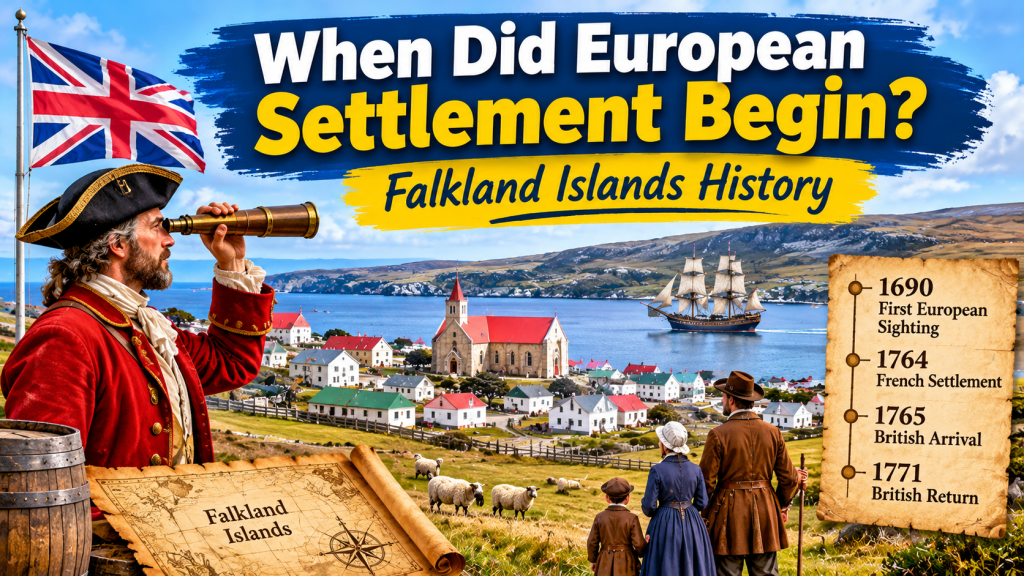
A confirmed European landing took place in 1690, when English captain John Strong sailed through the channel between the two main islands and named it Falkland Sound.
Permanent settlement followed much later.
In 1764, a French expedition led by Louis Antoine de Bougainville established a settlement at Port Louis on East Falkland. In 1765, a British expedition led by John Byron established a settlement claim at Saunders Island, and the British established a settlement at Port Egmont in 1766.
Spain subsequently took control of the French settlement through an agreement with France and later expelled the British from Port Egmont in 1770, before the British returned in 1771.
These early settlements formed part of a wider period of European competition for influence and territory in the South Atlantic.
During the nineteenth century, the islands experienced further political changes, economic development, and population growth. Sheep farming eventually became a major part of the local economy, helping shape the rural landscape and the lives of generations of residents.
These developments laid important foundations for the modern Falkland Islands community.
5. Where Did the Modern Falkland Islands Population Come From?
The modern Falkland Islands population developed through successive waves of migration and settlement.
British settlers and people from other parts of Europe contributed to the growth of local communities. Maritime workers, farmers, administrators, merchants, and their families all played roles in the islands’ development.
Over time, families established permanent homes and developed connections across the islands. Many residents today have family histories extending back several generations.
British cultural influences remain particularly visible in the English language, public institutions, education, and everyday customs.
However, the identity of Falkland Islanders is not simply a description of ancestry. It also reflects a shared experience of living in a remote island environment, maintaining communities across long distances, and adapting to changing economic and social conditions.
The result is a distinctive local identity shaped by both historical migration and generations of life in the South Atlantic.
6. What Is the Culture of Falkland Islanders Like?
The culture of the Falkland Islands reflects the islands’ British heritage, maritime surroundings, rural economy, and close-knit communities.
Stanley, the capital, is the principal population center. Its colorful buildings, harbor, churches, shops, and public institutions provide a glimpse into everyday life.
Outside Stanley, the islands feature extensive open landscapes, sheep farms, rugged coastlines, and small rural settlements. Life in these areas often requires independence, practical skills, and cooperation between neighbors.
Language and communication
English is the main language spoken in the Falkland Islands.
Local speech and expressions reflect the community’s history and everyday experiences. English is used in schools, businesses, government services, and social life.
Food and local traditions
Food traditions are influenced by British cooking and the practical requirements of island life.
Lamb and mutton have long been important because of the islands’ sheep-farming industry. Fish and other seafood also feature in local diets.
Community gatherings, family celebrations, and seasonal events provide opportunities for residents to maintain social connections.
Rural life and sheep farming
Sheep farming has historically played a major role in the islands’ economy and identity.
Rural work involves livestock management, maintaining fences, managing pastures, and adapting to challenging weather conditions. Sheep farming has also influenced the distribution of settlements and the development of transport across the islands.
These traditions remain an important part of the islands’ cultural history, even as modern industries and services have diversified the economy.
7. What Was the Role of the Warrah?
The warrah, also known as the Falkland Islands wolf, was a fox-like canid and the islands’ only native terrestrial land mammal known from historical times.
Its existence has long puzzled scientists because the Falkland Islands are isolated from mainland South America.
Charles Darwin encountered the warrah during his visit to the islands in the nineteenth century and discussed its unusual presence in his observations.
Researchers have proposed different explanations for how the animal reached the islands. Possibilities include natural dispersal during earlier geological conditions or transportation by humans.
The 2021 study on prehistoric human activity renewed interest in the possibility that Indigenous maritime travelers brought the warrah to the islands. However, this remains a hypothesis rather than a proven explanation.
The warrah was hunted to extinction in 1876, making its history an important part of the islands’ natural heritage.
Its story illustrates how questions about wildlife, human movement, and environmental history can be closely connected.
8. How Did the Falkland Islands Develop Into a Modern Community?
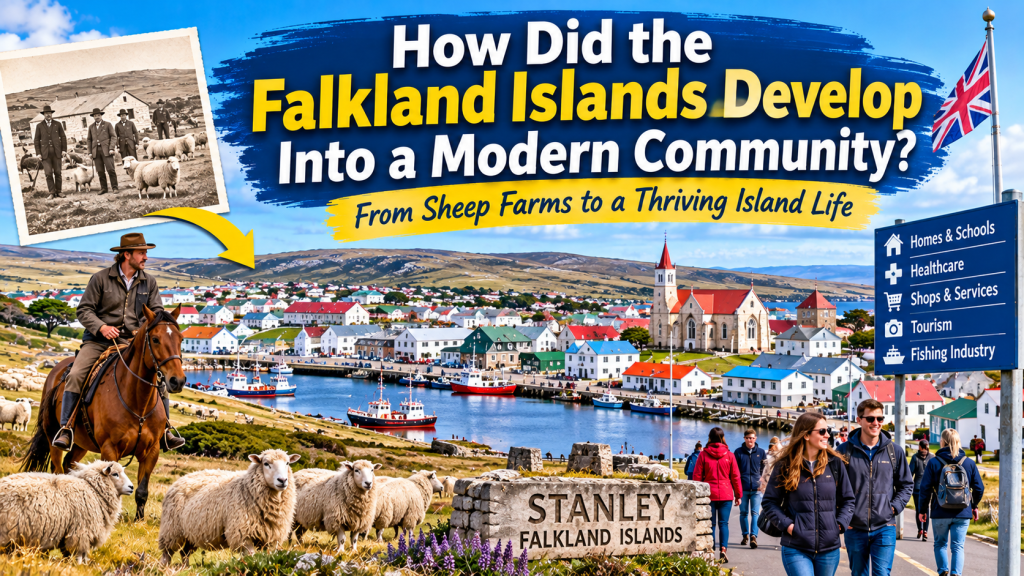
The development of the modern Falkland Islands community was influenced by geography, economic activity, and political history.
Sheep farming became central to the islands’ economy during the nineteenth century and continued to shape employment and settlement patterns for generations.
Stanley grew into the main administrative and commercial center, while rural settlements supported farming and other activities.
The twentieth century brought major changes, particularly during and after the 1982 Falklands War. The conflict had a profound effect on the community and remains an important part of the islands’ modern history.
In subsequent decades, investment in infrastructure, public services, communications, and local institutions helped shape contemporary life.
Fishing and other marine industries became increasingly important, while tourism developed around the islands’ wildlife, landscapes, history, and opportunities for outdoor activities.
Today, residents combine modern amenities with the realities of living in a remote location. The community maintains strong local connections while engaging with visitors and international partners.
9. Are Falkland Islanders Considered Indigenous People?
This question requires careful use of terminology.
The word “Indigenous” generally refers to peoples with historical continuity with societies that existed in a territory before colonization or the establishment of modern states.
The modern Falkland Islands population is primarily descended from settlers who arrived during the period of European settlement and their descendants. The community has developed its own local identity over many generations.
Whether people visited the islands before European settlement is a separate archaeological question. Even if future research establishes prehistoric visits by Indigenous South Americans, it would not automatically prove that the islands had a permanent Indigenous population or that a particular modern community descends from those visitors.
Likewise, being born in the Falkland Islands and belonging to its established local community is not the same thing as being Indigenous in the historical or anthropological sense.
Understanding these distinctions helps avoid confusion when researching the origins of the Falkland Islands natives.
10. Can Visitors Learn About the People and History of the Falkland Islands?
Yes. Travelers interested in local people and history can explore several places and experiences that provide insight into the islands’ heritage.
Explore Stanley
Stanley is an excellent starting point for understanding modern island life.
Visitors can walk along the waterfront, see historic buildings, visit local shops, and observe the everyday activities of the community.
The town’s architecture and public spaces reflect the history of settlement and the development of local institutions.
Visit the Falkland Islands Museum
The museum in Stanley offers information about the islands’ maritime history, settlement, natural environment, and the 1982 conflict.
It is a useful place to learn about the people who shaped the islands and the events that influenced their development.
Discover the rural settlements
Travel beyond Stanley to experience the islands’ rural character.
Farms, open landscapes, remote coastlines, and small settlements provide a different perspective on life in the Falklands.
Visitors should plan transport carefully because distances can be considerable and services outside Stanley may be limited.
Learn about local wildlife
The islands are famous for penguins, seals, albatrosses, and other wildlife.
Although wildlife does not directly explain human ancestry, it helps visitors understand the environment that has influenced local livelihoods and traditions.
Responsible wildlife viewing is essential. Follow local guidance, respect access restrictions, and maintain appropriate distances from animals.
11. What Does the Future Hold for Research Into the First Inhabitants?
Research into the earliest human presence in the Falkland Islands is ongoing, and future discoveries may change what historians and archaeologists understand about the islands.
Scientists may investigate additional archaeological sites, examine previously collected artifacts, and use improved dating methods to evaluate the age of charcoal, bones, and other materials.
Collaboration with Indigenous communities in southern South America may also contribute valuable knowledge about maritime traditions, historical movement, and regional oral histories.
However, responsible research requires distinguishing evidence from speculation.
A single artifact or unusual environmental pattern cannot answer every question about who visited the islands, when they arrived, or why they traveled there.
Further discoveries will need to be assessed carefully and compared with other evidence before a reliable account of the earliest human history can be established.
For travelers and history enthusiasts, this uncertainty makes the subject especially interesting: the story of the Falkland Islands continues to be investigated.
Conclusion: Who Were the Original Inhabitants of the Falkland Islands?
The question of who the Falkland Islands natives were has no simple answer.
The modern population developed primarily through European settlement, particularly from Britain, and has built a distinctive local culture over generations. English is the main language, while sheep farming, maritime industries, wildlife, and close-knit communities have all influenced the islands’ identity.
Whether Indigenous South Americans visited the islands before European exploration remains an important research question. A 2021 study presented evidence consistent with prehistoric human activity, while a later scholarly review argued that the evidence was not yet conclusive.
For this reason, it is best to distinguish between the documented history of permanent settlement and the possibility of earlier human visits.
Understanding both perspectives provides a more balanced picture of the Falkland Islands’ past. It also highlights why continued archaeological research matters for anyone interested in the people, culture, and history of this remote South Atlantic archipelago.
Frequently Asked Questions (FAQs)
1. Who are the natives of the Falkland Islands?
The modern local population is known as Falkland Islanders. It developed primarily through European settlement and subsequent generations of local families. The question of possible prehistoric Indigenous visitors remains debated.
2. Were the Falkland Islands inhabited before Europeans arrived?
There is no conclusive, widely accepted evidence of a permanent Indigenous population before European settlement. However, a 2021 scientific study identified evidence consistent with possible human activity centuries before Europeans arrived.
3. Which Indigenous people may have visited the Falkland Islands?
Some researchers have suggested that the Yaghan (Yámana), or related maritime peoples from Tierra del Fuego, may have reached the islands. This possibility has not been conclusively established.
4. Where did Falkland Islanders originally come from?
The modern population developed through settlement and migration, particularly from Britain and other parts of Europe. Many local families have lived in the islands for multiple generations.
5. What language do Falkland Islanders speak?
English is the main language spoken in the Falkland Islands. Local expressions and speech patterns reflect the community’s history and culture.
6. What is the warrah?
The warrah was a fox-like canid native to the Falkland Islands. It became extinct in 1876. Its origins remain scientifically interesting, including the possibility that humans helped transport its ancestors to the islands.
7. Where can visitors learn about Falkland Islands history?
Visitors can explore Stanley, visit the Falkland Islands Museum, discover rural settlements, and learn about the islands’ maritime heritage and wildlife.
8. Is the history of the Falkland Islands still being researched?
Yes. Researchers continue to examine archaeological, environmental, and historical evidence to understand the possibility of human visits before European settlement.