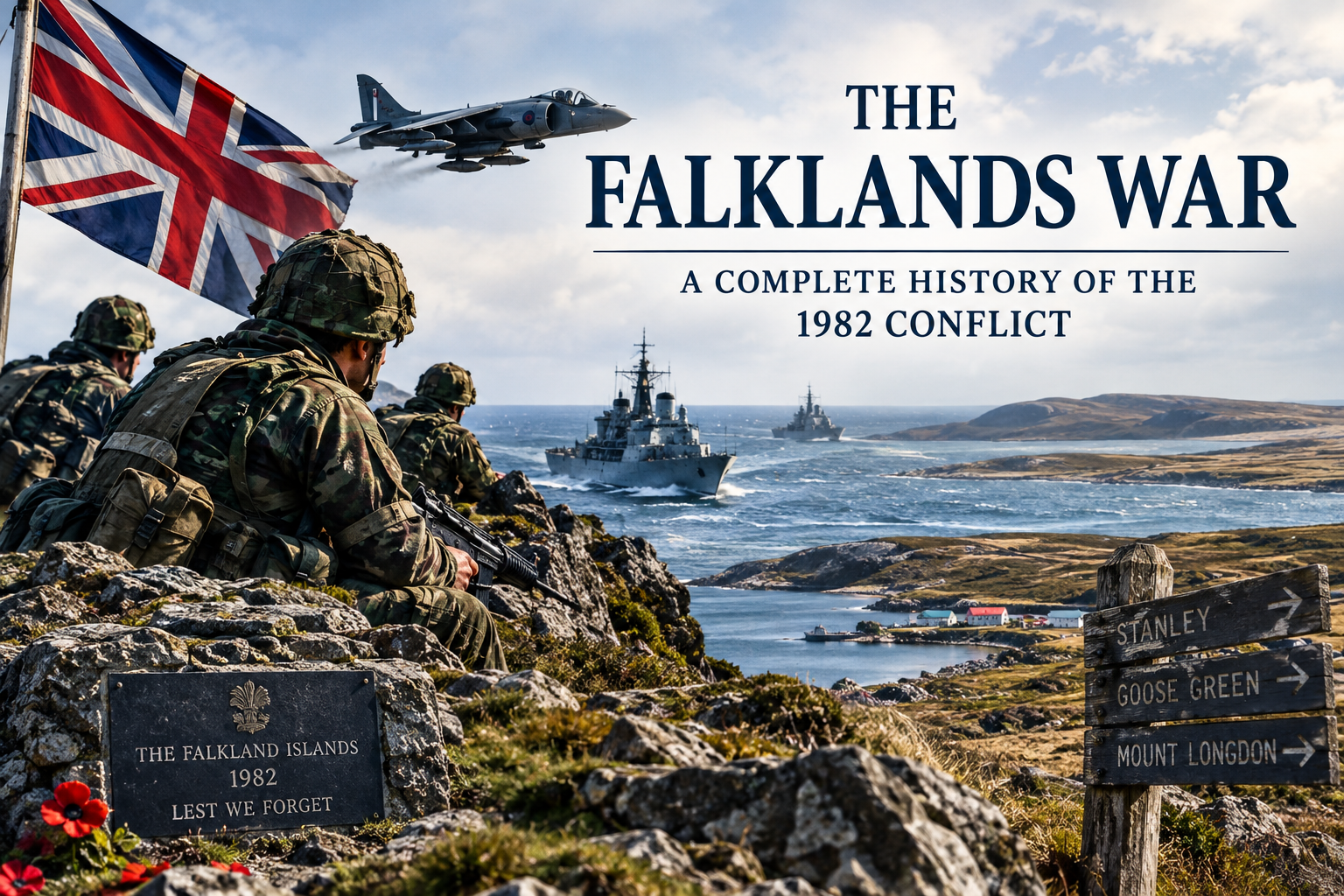
The Falklands War was a 74-day conflict between the United Kingdom and Argentina in 1982 over the sovereignty of the Falkland Islands. Fought thousands of miles from Britain and mainland Argentina, the war involved intense land, sea, and air combat and became one of the most significant conflicts of the late 20th century.
For visitors interested in Falklands history, understanding the war provides important context for many of the islands’ memorials, battlefields, monuments, museums, and historic sites. From the initial Argentine invasion to the final battles around Stanley, the events of 1982 continue to shape the identity and history of the Falkland Islands.
What Was the Falklands War?
The Falklands War began on April 2, 1982, when Argentine forces invaded and occupied the Falkland Islands. Argentina claimed sovereignty over the islands, which it calls the Islas Malvinas, while Britain had administered the Falklands since the 19th century.
The British government responded by sending a large naval task force to the South Atlantic to retake the islands.
The conflict lasted from April until June 14, 1982, when Argentine forces in Stanley surrendered. Fighting took place around the islands, including important battles at Goose Green, Mount Longdon, Mount Harriet, Two Sisters, Mount Tumbledown, and Wireless Ridge.
The war resulted in significant military and civilian casualties on both sides.
Why Did the Falklands War Happen?
The origins of the Falklands War go back much further than 1982.
Britain and Argentina had disputed sovereignty over the Falkland Islands for generations. Argentina maintained that the islands were part of its national territory, while Britain maintained its claim based on its historical presence and administration.
By the late 1970s and early 1980s, the sovereignty dispute remained unresolved.
Argentina was also experiencing serious domestic problems. The military government faced economic difficulties and growing political opposition. In this environment, the Falkland Islands dispute became an increasingly important national issue.
On April 2, 1982, Argentine forces landed on the islands and quickly overwhelmed the small British garrison.
The Argentine government expected Britain to negotiate rather than launch a major military operation thousands of miles away.
That assumption proved incorrect.
The Argentine Invasion
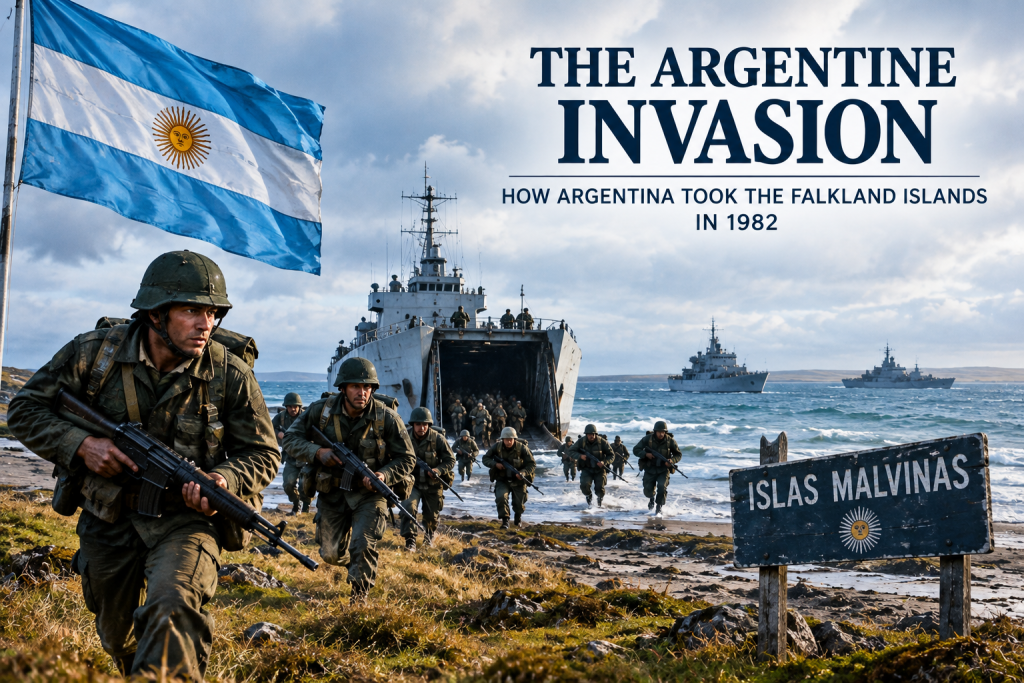
The invasion began in the early hours of April 2.
Argentine troops landed near Stanley, the capital of the Falkland Islands. The small Royal Marines garrison was heavily outnumbered and eventually surrendered.
Although the invasion was completed quickly, Britain immediately rejected Argentina’s occupation.
The British government under Prime Minister Margaret Thatcher announced that a military task force would be sent to the South Atlantic.
For the people living on the Falkland Islands, the invasion meant a sudden and dramatic change to everyday life.
The islands were placed under Argentine military control, and the occupation lasted until British forces returned.
Britain Sends a Task Force
Britain assembled one of the largest military operations it had undertaken since the Second World War.
A naval task force sailed south carrying Royal Navy warships, support vessels, aircraft, Royal Marines, and British Army units.
The distance created enormous logistical challenges.
The Falkland Islands are located in the South Atlantic, more than 8,000 miles from the United Kingdom. Supplying a military force at such a distance required extensive planning and coordination.
British forces had to operate far from their normal bases while dealing with difficult weather, rough seas, and limited infrastructure on the islands.
The Royal Navy played a central role in transporting and protecting the task force.
The War at Sea
Naval warfare became one of the defining aspects of the Falklands War.
One of the most famous events occurred on May 2, 1982, when the Argentine cruiser General Belgrano was sunk by the British submarine HMS Conqueror.
The sinking resulted in the deaths of hundreds of Argentine sailors and remains one of the most controversial events of the conflict.
The British fleet also suffered major losses.
On May 4, the British destroyer HMS Sheffield was struck by an Argentine Exocet missile and eventually sank.
Other British ships were attacked during the campaign, demonstrating the serious threat posed by Argentine aircraft and missiles.
The naval campaign showed how vulnerable modern warships could be when operating within range of hostile aircraft and missiles.
The Air War
Air combat was another crucial part of the conflict.
Argentine aircraft launched repeated attacks against British ships and forces.
Despite operating from bases on mainland Argentina, Argentine pilots had to fly long distances to reach the islands and British fleet.
British Sea Harrier aircraft played an important role in defending the task force.
Their ability to operate from aircraft carriers and conduct air-to-air combat gave Britain an important advantage.
The air war was extremely dangerous for both sides. Several aircraft and ships were lost during the campaign.
The Argentine Air Force and Argentine Navy aviation units demonstrated considerable determination and successfully attacked a number of British vessels.
The British Landings
After weeks of naval and air operations, British forces began landing on East Falkland.
The main landing took place at San Carlos Water on May 21.
British troops established a beachhead and began moving across East Falkland toward Stanley.
The Argentine forces defending the islands were concentrated around strategic positions, while British troops faced difficult terrain and harsh weather.
The campaign then shifted into a series of major land battles.
The Battle of Goose Green
One of the best-known battles of the Falklands War was the Battle of Goose Green.
The battle took place between May 28 and 29 and involved British forces, particularly the 2nd Battalion, Parachute Regiment, and Argentine defenders.
The fighting was intense and resulted in significant casualties.
British forces eventually captured Goose Green and Darwin.
The battle became an important turning point because it demonstrated that Argentine forces could be defeated in ground combat.
The Goose Green area remains historically significant and is one of the places associated with the Falklands War that visitors may encounter when exploring the islands.
The Battles Around Stanley
Following the victory at Goose Green, British forces continued their advance toward Stanley.
Several strategically important hills had to be captured before the capital could be surrounded.
Among them were:
- Mount Longdon
- Mount Harriet
- Two Sisters
- Mount Tumbledown
- Wireless Ridge
These battles were fought during extremely difficult conditions.
British troops moved across rough terrain, often at night, while Argentine forces defended heavily positioned hills.
The fighting around these locations was some of the most intense of the entire war.
Mount Longdon
The Battle of Mount Longdon took place on the night of June 11–12.
British Paratroopers attacked Argentine positions on the mountain in a difficult nighttime assault.
The battle involved close fighting and resulted in heavy casualties.
Mount Longdon was strategically important because controlling the high ground helped British forces move closer to Stanley.
Today, Mount Longdon is one of the most significant battlefield locations associated with the conflict.
Mount Tumbledown and Wireless Ridge
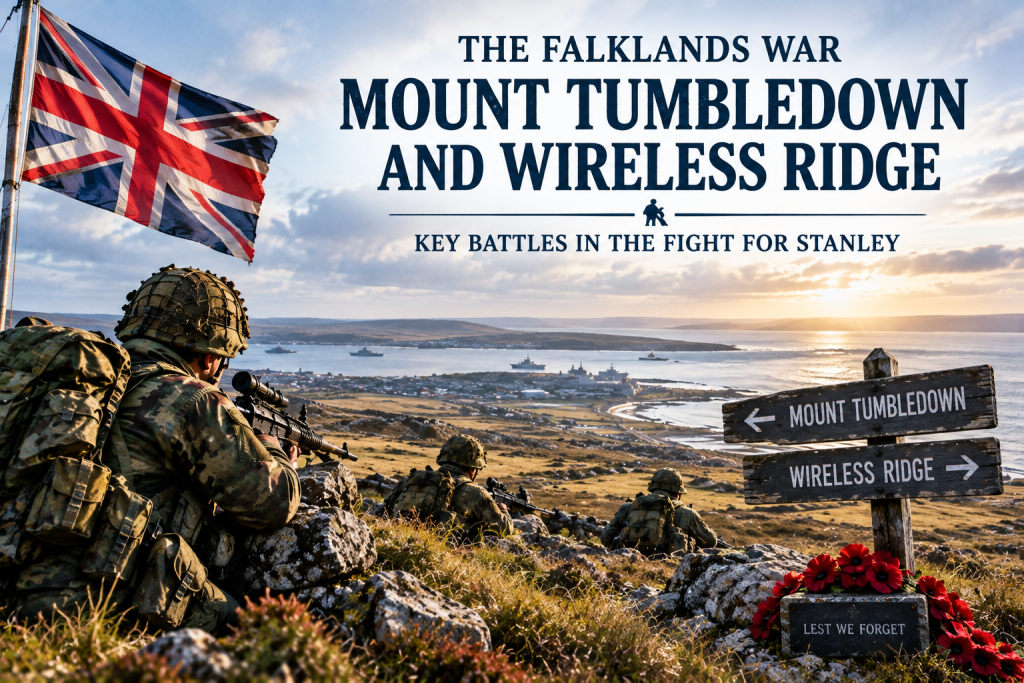
On June 13, British forces launched further attacks on Argentine defensive positions.
Mount Tumbledown was defended by Argentine troops, including elements of the Argentine Marine Corps.
British forces eventually captured the mountain after fierce fighting.
At the same time, British troops attacked Wireless Ridge.
The capture of these positions brought Argentine defenses around Stanley close to collapse.
British forces were now in a position to threaten the capital directly.
The Surrender at Stanley
By June 14, Argentine forces in Stanley were surrounded.
With British troops controlling the key heights around the capital, Argentine commander General Mario Menéndez surrendered to Major General Jeremy Moore.
The surrender effectively ended major combat.
The Falklands War had lasted 74 days.
The British had regained control of the islands, while Argentina continued to maintain its sovereignty claim.
Casualties of the Falklands War
The conflict caused significant loss of life.
Around 649 Argentine military personnel died during the war, along with more than 250 British military personnel. Three Falkland Islanders were also killed.
Many others were wounded physically or affected by the psychological consequences of combat.
The human cost of the conflict remains an important part of Falklands history.
War memorials and cemeteries across the islands commemorate those who lost their lives.
The Falklands War and the Islands Today
The legacy of the war can still be seen throughout the Falkland Islands.
Visitors can explore museums, memorials, monuments, battlefields, shipwreck-related sites, and other locations connected with the conflict.
Stanley is particularly important for understanding the history of 1982.
The Historic Dockyard Museum contains exhibits covering the islands’ history, including the Falklands War.
Outside Stanley, battlefield areas such as Goose Green, Mount Longdon, Mount Tumbledown, Mount Harriet, and Wireless Ridge provide a deeper connection to the events of 1982.
However, visitors should remember that some battlefield areas contain unexploded ordnance and landmines. Travelers should always follow local guidance and remain on safe, designated routes.
Why the Falklands War Still Matters
The Falklands War remains historically important for several reasons.
It changed the political relationship between Britain and Argentina and had major consequences for both countries.
For Britain, the victory strengthened the government of Margaret Thatcher and became an important part of modern British military history.
For Argentina, the defeat contributed to the eventual decline of military rule and the country’s return to democracy.
For the Falkland Islanders, the war became a defining moment in the islands’ modern history.
The sovereignty dispute itself did not disappear after 1982. Argentina continues to claim the islands, while the Falkland Islands remain under British administration.
Visiting Falklands War History Sites
For travelers interested in military history, the Falkland Islands offer an unusual opportunity to explore locations connected directly with a modern conflict.
A visit can include time in Stanley, where museums and memorials provide historical context, followed by trips to important battlefield locations.
Visitors should plan carefully because many sites are remote and weather conditions can change quickly.
Respect for the landscape and the people affected by the conflict is also essential.
Battlefield tourism should not simply be about military equipment or combat. It is also an opportunity to understand the experiences of soldiers, islanders, and families whose lives were changed by the war.
Final Thoughts
The Falklands War was a short but intense conflict that transformed the history of the Falkland Islands.
Beginning with the Argentine invasion on April 2, 1982, and ending with the surrender at Stanley on June 14, the war involved major naval, air, and land battles.
Today, the history of 1982 remains visible across the islands through battlefields, memorials, museums, monuments, and historic sites.
For anyone visiting the Falkland Islands, learning about the war provides valuable context for understanding the landscape and the communities that call these remote islands home.
The Falklands War was not simply a conflict fought thousands of miles from Britain and Argentina. It was an event that continues to influence the identity, history, and international significance of the Falkland Islands today.